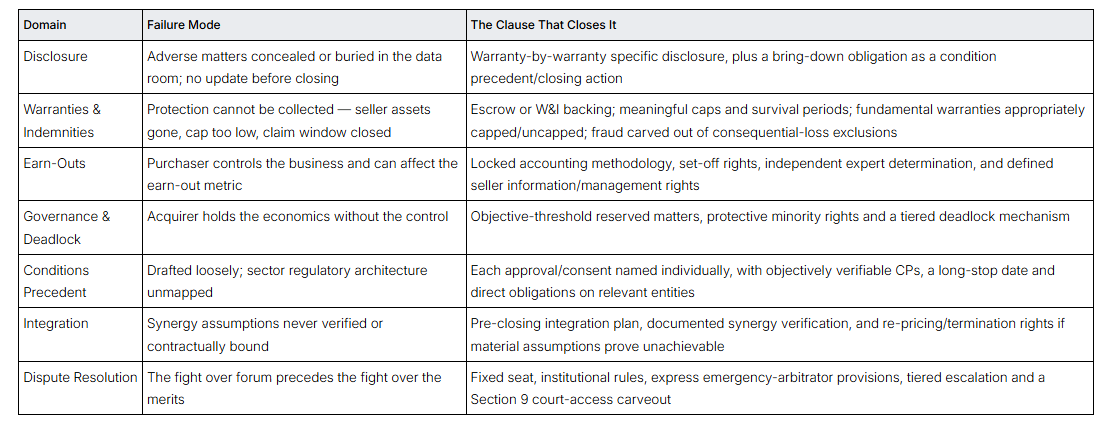
In 2008, Daiichi Sankyo paid USD 4.6 billion for control of Ranbaxy. Five years later, Ranbaxy's US subsidiary pleaded guilty to seven federal felony counts and paid USD 500 million; a decade later, Daiichi was still in the Indian courts enforcing an arbitral award against the sellers. None of that was unforeseeable - it was undisclosed, and the transaction documents did not appropriately allocate the risk. Most failed and distressed acquisitions follow that pattern. Non-disclosure, underfunded indemnities, governance deadlock, integration collapse - the common root is a contractual gap. This note examines seven domains where acquirers suffer preventable losses, illustrated by Indian and cross-border case studies, and concludes with emerging clauses gaining traction in Indian deal practice. The analysis is framed from the acquirer’s perspective, with the recommendations reflecting a buy-side approach. Some of these positions may therefore be expected to attract pushback from seller’s counsel.
A. Where the Risk Line Is Drawn
The disclosure letter and schedule mark the boundary between accepted risk and warranty breach. A defective or fraudulently populated disclosure regime turns the acquisition agreement into a one-way loss ticket — all risk lands with the acquirer.
B. The Daiichi Sankyo / Ranbaxy Acquisition: Concealment at Scale
The Daiichi Sankyo / Ranbaxy transaction is India's defining M&A case study on non-disclosure. In 2008, Daiichi Sankyo acquired a controlling stake in Ranbaxy for USD 4.6 billion. Ranbaxy's promoters concealed systemic data integrity and manufacturing deficiencies under USFDA scrutiny. The deal closed. It is pertinent to note that under the teams of the deal, Daiichi Sankyo did not have indemnity from actions taken prior to the 2008 purchase.
In 2013, Ranbaxy USA Inc. pleaded guilty to seven federal felony counts and paid USD 500 million, the then largest drug safety settlement involving a generic pharmaceutical company. Daiichi Sankyo successfully pursued ICC arbitration (Singapore seat). The Delhi High Court later enforced an award of approximately INR 35 billion against the promoters after prolonged litigation. The clause that would have prevented this: a specific warranty covering pending and threatened regulatory action, backed by escrow, adequate indemnity coverage and an express pro-sandbagging provision.
C. Verizon / Yahoo: Cyber Non-Disclosure and Price Impact
Verizon's acquisition of Yahoo's core internet assets closed at USD 4.48 billion, USD 350 million below the originally agreed USD 4.83 billion. The reduction followed Yahoo's disclosure, only after signing, of two massive pre-signing data breaches: a 2014 breach affecting approximately 500 million accounts and a 2013 breach affecting all three billion then-existing accounts. The case established that disclosure obligations should extend to cyber incidents, a risk largely overlooked in standard disclosure regimes at the time. It also highlighted that delayed or partial disclosure to an acquirer, without sufficient time for diligence, is itself a deficiency that transaction documents must address. The clause that would have prevented this: a cyber-incident warranty with a defined lookback period, coupled with a bring-down disclosure obligation at closing.
D. Preventive Drafting: Robust Disclosure Mechanisms
A. Protection You Cannot Collect
A warranty and indemnity framework is only as valuable as the ability to collect on it. Elaborate protections mean nothing if the recovery mechanism fails, because the seller has no assets left, the claim window has closed, the cap is too low, or the obligation is unsecured.
B. Common Breaches and Recovery Challenges
In the Prodapt-Synophic case, Prodapt acquired Synophic Systems and then discovered undisclosed breaches of ethics policies with its major client, Cisco. The Madras High Court ordered the seller to provide security for potential damages, protecting the buyer's position while the claim was resolved. In GWL Properties, the Bombay High Court upheld an arbitral award for the buyer where the seller's representations about the recoverability of the target subsidiary's receivables proved false.
C. Key Drafting Disciplines
A. Who Controls the Numerator
Earn-outs bridge valuation gaps: the deferred consideration is tied to post-acquisition financial, operational, or commercial milestones. In India, most earn-outs are purchasercontrolled, and legitimately so - having assumed ownership, funding obligations, and business risk on closing, the acquirer requires strategic control over financing, restructuring, and related-party dealings, while operational control to integrate the target, standardize reporting, and run the business also passes to it, the execution continues to depend on the sellers/erstwhile promoters. This is a natural incident of change of ownership, not an anomaly. The friction arises because the same control the acquirer exercises over the business also determines the numerator of the earn-out formula, leaving the seller's earnout consideration exposed to ordinary post-acquisition decisions like cost reallocation, capital expenditure prioritisation, customer and channel management. This may be commercially justified at the group level but nonetheless depress earn-out outcomes, whether or not any bad faith is intended. Absent clear contractual guardrails, this asymmetry, i.e. legitimate acquirer control on one side and seller dependence on the resulting numbers on the other is what drives the disputes discussed below.
B. Common Disputes
C. The Indian Courts' Approach
Indian courts set a high bar before filling gaps in earn-out contracts. If the contract makes commercial sense without the term, the court will not read it in. This severely limits Nabha Power Ltd. v. Punjab State Power Corporation Ltd.2 applied the business-efficacy and officiousbystander tests, holding that a term may be implied only where it is reasonable and equitable, necessary to give the contract business efficacy, any scope to imply a good-faith obligation on the acquirer during the earn-out period. Explicit drafting is the only protection.
Preventive Drafting: Earn-Out Protections
A. The Hostage Position
Phased acquisitions, particularly initial minority stakes with options to acquire control, and incomplete acquisitions regularly produce governance gridlock. A "promoter" is a person who has control over the affairs of the company, is named as such in a prospectus or the annual return, or on whose advice the board is accustomed to act, as defined under Section 2(69) of the Companies Act, 2013. Where an acquirer holds a significant but non-controlling stake alongside such a promoter who retains control, absent robust governance protections may lead to a hostage situation.
B. Diageo / United Spirits: A Study in Governance Complexity
Diageo acquired United Spirits Limited ("USL") in multiple tranches, starting with a minority stake in 2012 and culminating in majority control. Navigating SEBI Takeover Code compliance and conducting an open offer to public shareholders meant Diageo held a significant stake without full management control for an extended period — generating governance tensions, including the protracted and contentious separation of Vijay Mallya, that the acquisition agreement alone could not resolve. The case shows how gaps in interim governance arrangements between minority stake acquisition and full control generate legal, regulatory, and reputational exposure. The clause that would have prevented this: protective minority rights and defined information rights, binding for the whole interim period.
C. ZEEL / Sony Pictures: Leadership Deadlock as Deal-Killer
The proposed USD 10 billion merger between Zee Entertainment Enterprises Limited ("ZEEL") and Sony Pictures Networks India collapsed in January 2024. The decisive cause was leadership: SEBI's June 2023 Interim Order barred ZEEL's MD and CEO, Punit Goenka, from management roles in listed companies over fund misappropriation allegations. SAT ultimately set the order aside, but the regulatory cloud over the designated post-merger CEO made the governance structure untenable for Sony.
Sony terminated the merger, claiming a USD 90 million termination fee from ZEEL via SIAC arbitration. ZEEL sought NCLT intervention initially, then pivoted to SIAC and, in May 2024, counter-claimed the same USD 90 million from Sony's group entities. Both sides withdrew all claims in a comprehensive non-cash settlement in July 2024. ZEEL's merger-related costs came to approximately INR 4.32 billion — a loss attributable directly to a deal that lacked welldefined breakup fee mechanics and governance conditions from the outset. The clause that would have prevented this: a governance condition precedent tied to the designated CEO's regulatory clearance, with a pre-agreed replacement mechanism and defined termination-fee consequences.
D. Preventive Drafting: Governance Protections
A. Gates That Do Not Close
Conditions precedent are the gating mechanisms that ensure a deal closes only once all necessary regulatory approvals, third-party consents, and pre-completion restructuring are in place. Get them wrong, define them too loosely, fail to satisfy them, or close prematurely — the acquirer is locked into an asset with fundamental deficiencies it cannot unwind.
B. Apollo Tyres / Cooper Tire: Labour Conditions as Deal-Breakers
Apollo Tyres Limited and Cooper Tire & Rubber Company agreed to merge in June 2013 for approximately USD 2.5 billion. The deal broke down on two fronts. First, Cooper's Chinese joint venture partner, Chengshan Group, seized control of the Chinese facility, refused to produce tyres, withheld financial records, and barred Cooper's officials from the plant. Cooper could not deliver the consolidated financial data required for closing. The Delaware Chancery Court held that Cooper could not satisfy the sale conditions and could not force Apollo to close. Second, a U.S. arbitrator blocked the transfer of two Cooper plants pending a new collective bargaining agreement with USW union. Cooper terminated the merger on December 30, 2013. The lessons: JV change-of-control cooperation rights and labour/union obligations are not boilerplate — they must be named conditions precedent to closing.
C. HDFC Life / Max Life: The Regulatory Architecture Matters
The proposed merger between HDFC Life Insurance Company Limited and Max Life Insurance Company Limited was abandoned after IRDAI declined to approve the proposed structure. The deal demonstrated that sector-specific regulatory constraints, including the corporate structure restrictions applicable to regulated entities, must be comprehensively mapped and specifically addressed in the conditions precedent before signing. The clause that would have prevented this: each regulatory approval named individually as an objectively verifiable conditions precedent, following a pre-signing sector regulatory review.
D. Amazon.com NV Investment Holdings / Future Coupons Pvt. Ltd.: The Anti-Assignment Condition and Emergency Arbitration
In August 2019, Amazon.com NV Investment Holdings LLC ("Amazon") agreed to invest approximately INR 1,431 crore in Future Coupons Private Limited ("FCPL") for a 49% stake. The transaction received CCI approval in November 2019.
In August 2020, Future Retail Limited (“FRL”) approved a transaction involving the transfer of its retail, wholesale, logistics and warehousing businesses to Reliance Retail Ventures Limited ("Reliance") for approximately ₹24,713 crore. Amazon contended that the transaction breached the contractual restrictions and protective rights contained in the inter-linked agreements. Amazon initiated SIAC arbitration, and in October 2020 the Emergency Arbitrator issued an interim award restraining the transaction.
In August 2021, the Supreme Court held that the emergency arbitrator's order was enforceable in India under Section 17(2) of the Arbitration and Conciliation Act, 1996.
Notwithstanding this legal victory, the Reliance transaction was ultimately not consummated in the form originally contemplated. Reliance subsequently took control of a substantial number of FRL's stores through lease and related arrangements. FRL thereafter entered corporate insolvency resolution proceedings under the Insolvency and Bankruptcy Code, 2016, with the NCLT admitting the insolvency proceedings on 20 July 2022. The subsequent insolvency process further limited the practical ability to enforce Amazon's contractual protections outside the statutory insolvency framework.
Two specific failure points from Amazon/Future Retail case are worth examining in detail:
E. Preventive Drafting: Conditions Precedent
A. Where the Value Leaks Out
Most acquisition value destruction happens not at signing or closing, but in the 12–36 months that follow, essentially the integration phase.
B. Sun Pharma / Ranbaxy: Integration as Regulatory Risk
When Sun Pharmaceutical Industries agreed to acquire Ranbaxy Laboratories in April 2014, completing the transaction in March 2015, it inherited a substantial portfolio of pre-existing regulatory and compliance issues at Ranbaxy, including ongoing USFDA enforcement actions, import alerts affecting multiple manufacturing facilities and significant remediation requirements. The post-acquisition integration presented additional challenges, including differences in organisational and work cultures, significant attrition among Ranbaxy's senior personnel, and the integration of Ranbaxy's extensive international and emerging-market operations. A more targeted contractual risk-allocation framework could have included a specific indemnity for identified pre-closing regulatory liabilities and remediation costs, subject to an agreed cap and survival period, together with appropriate retention arrangements for identified key personnel.
C. Tata Steel / Corus: The Overvaluation and Integration Premium Problem
In April 2007, Tata Steel completed its acquisition of Corus Group plc for approximately £6.2 billion (US$12 billion), then the largest overseas acquisition by an Indian company. Following a competitive auction against Brazil's Companhia Siderúrgica Nacional, Tata's final offer represented a significant premium to Corus's average share price over the preceding 12 months. The acquisition involved substantial debt financing, including significant nonrecourse long-term debt at Tata Steel UK.
The strategic rationale was to combine Tata Steel's low-cost Indian operations and rawmaterial advantages with Corus's European downstream capabilities and high-value-added product portfolio. However, the anticipated raw-material advantage proved difficult to replicate: post-acquisition, Tata disclosed that the combined group's captive raw-material security was substantially lower than Tata Steel's standalone position, while Corus remained exposed to global iron ore, metallurgical coal and scrap prices.
The global financial crisis severely affected the European operations, resulting in significant losses and, despite subsequent recovery, a substantial impairment of Corus-related goodwill and European assets in 2013.
Integration also exposed differences in organisational, labour and operating practices. Tata had identified significant potential synergies, but subsequent performance demonstrated the difficulty of converting projected synergies into sustainable value in a structurally challenged market.
D. Preventive Drafting: Integration Covenants
A. Fighting About Where to Fight
A poorly drafted dispute resolution clause creates disputes about how to resolve the dispute, generally battles over jurisdiction, applicable law, arbitral seat, institutional rules, and the scope of the clause even before the underlying commercial issue can even be addressed.
B. ZEEL / Sony: Arbitration in the Aftermath
ZEEL's initial instinct after the merger collapsed was to approach the NCLT — a forum that could not give it what it needed once Sony had terminated. The case is a reminder to think through the full dispute resolution architecture at signing.
C. Daiichi Sankyo / Ranbaxy: Enforcement of Foreign Awards in India
Enforcing the ICC award Daiichi Sankyo obtained against Ranbaxy's promoters took years of Indian court proceedings and required Supreme Court intervention. Even a validly obtained foreign award can be held up in India through public policy objections under Section 48(2)(b) of the Arbitration and Conciliation Act, 1996. Avitel Post Studioz Ltd. v. HSBC PI Holdings (Mauritius) Ltd.3 confirmed that enforcement may be refused on grounds such as arbitrator bias only in exceptional circumstances but the process itself is the punishment.
D. Amazon / Future Retail: Emergency Arbitration and Enforcement
Amazon/Future Retail illustrates two lessons for emergency arbitration in Indian M&A. First, the Supreme Court's August 2021 ruling held that an emergency arbitrator under the SIAC Rules falls within "arbitral tribunal" under the Arbitration Act, making its interim order enforceable under Section 17(2). Second, the period between the October 2020 EA order and the August 2021 ruling saw the commercial position evolve substantially, underscoring the importance of timely interim relief in M&A disputes. When FRL entered IBC proceedings in July 2022, the Section 14 moratorium constrained Amazon's ability to pursue proceedings against FRL and reduced the practical utility of remedies against its assets.
The Draft Arbitration and Conciliation (Amendment) Bill, 2024 proposes a new Section 9A expressly recognizing emergency arbitration. However, it remains a draft and has not been enacted. While the proposed proviso to Section 2(2) extends Section 9A(2) to foreign-seated arbitrations, it does not expressly extend Section 9A(3), which provides for enforcement of EA orders, leaving uncertainty over enforcement of emergency orders from foreign-seated SIAC, ICC and other institutional arbitrations in India.
For Indian M&A, the lesson is to pair emergency-arbitration rights with carefully drafted negative covenants, appropriate security or structural protections, and measures designed to preserve value notwithstanding a subsequent insolvency.
E. Preventive Drafting: Dispute Resolution
F. Arbitrability and the NCLT — Knowing When Arbitration Cannot Be the Exclusive Forum
A critical limitation of arbitration clauses in Indian M&A is that not all M&A-related disputes are arbitrable. The ZEEL/Sony case itself illustrates this: ZEEL's initial instinct was to approach the NCLT to enforce the merger scheme — correctly recognising that matters involving courtsanctioned schemes of arrangement under the Companies Act, 2013 engage NCLT jurisdiction that cannot be ousted by an arbitration clause. Similarly, claims of oppression and mismanagement under Sections 241-244 of the Companies Act, 2013 may not be arbitrable where the relief sought is inherently corporate in nature. Acquirers and their counsel must therefore map the dispute resolution architecture of an M&A transaction across multiple dimensions:
Acquisition agreements should address this complexity by specifying which categories of dispute are subject to the arbitration clause and which are reserved for statutory forums, rather than using omnibus "all disputes" arbitration language that may be challenged in the most commercially critical situations.
Every case study in this note, from Ranbaxy’s concealed regulatory crisis and the ZEEL/Sony governance collapse to Apollo/Cooper’s labour and JV breakdown, Amazon’s IBC-neutralised arbitration victory, and the decade of value erosion at Tata Steel Europe, points to the same underlying pattern: risks were not adequately disclosed or ring-fenced; indemnities were not sufficiently secured; earn-outs and governance arrangements left room for disputes; conditions precedent failed to capture critical gates; integration assumptions went untested; and dispute mechanisms were not built for effective enforcement.
All in all, failed acquisitions rarely fail because there was no contract. Rather, it reflects a failure to design the contractual architecture to adequately capture, allocate, and protect against the risks that ultimately materialised.
For acquirers, the lesson is clear that every material risk should have a defined owner, a clear trigger, an enforceable remedy and, where necessary, a reliable source of recovery. The contract should not merely document the deal as contemplated rather it should anticipate and build upon what could go wrong.
As India’s M&A market becomes more complex, three shifts are particularly relevant: W&I insurance moving towards broader adoption, earn-out disputes increasingly moving to independent expert determination, and emergency arbitration becoming an increasingly important tool for urgent protection.
These developments reinforce one fundamental point: contractual risk allocation is not merely a drafting exercise, it is a core part of transaction strategy. The real test of an agreement is not whether the deal closes, it is whether the contract protects the acquirer when the deal goes wrong.
Footnotes
1. GWL Properties Ltd. v. James Mackintosh & Company Private Limited, 2012 SCC OnLine Bom 404 (Bombay High Court, 16 March 2012).
2. Nabha Power Ltd. v. Punjab State Power Corporation Ltd., (2018) 11 SCC 508.
3. 2024 SCC OnLine SC 345 (Supreme Court of India, 4 March 2024).
The content of this article is intended to provide a general guide to the subject matter. Specialist advice should be sought about your specific circumstances.